Publish Content That Keeps
Your Brand Moving.
Plan and create useful, search-focused content around the topics your audience
cares about, with a structured workflow from research to finished article.
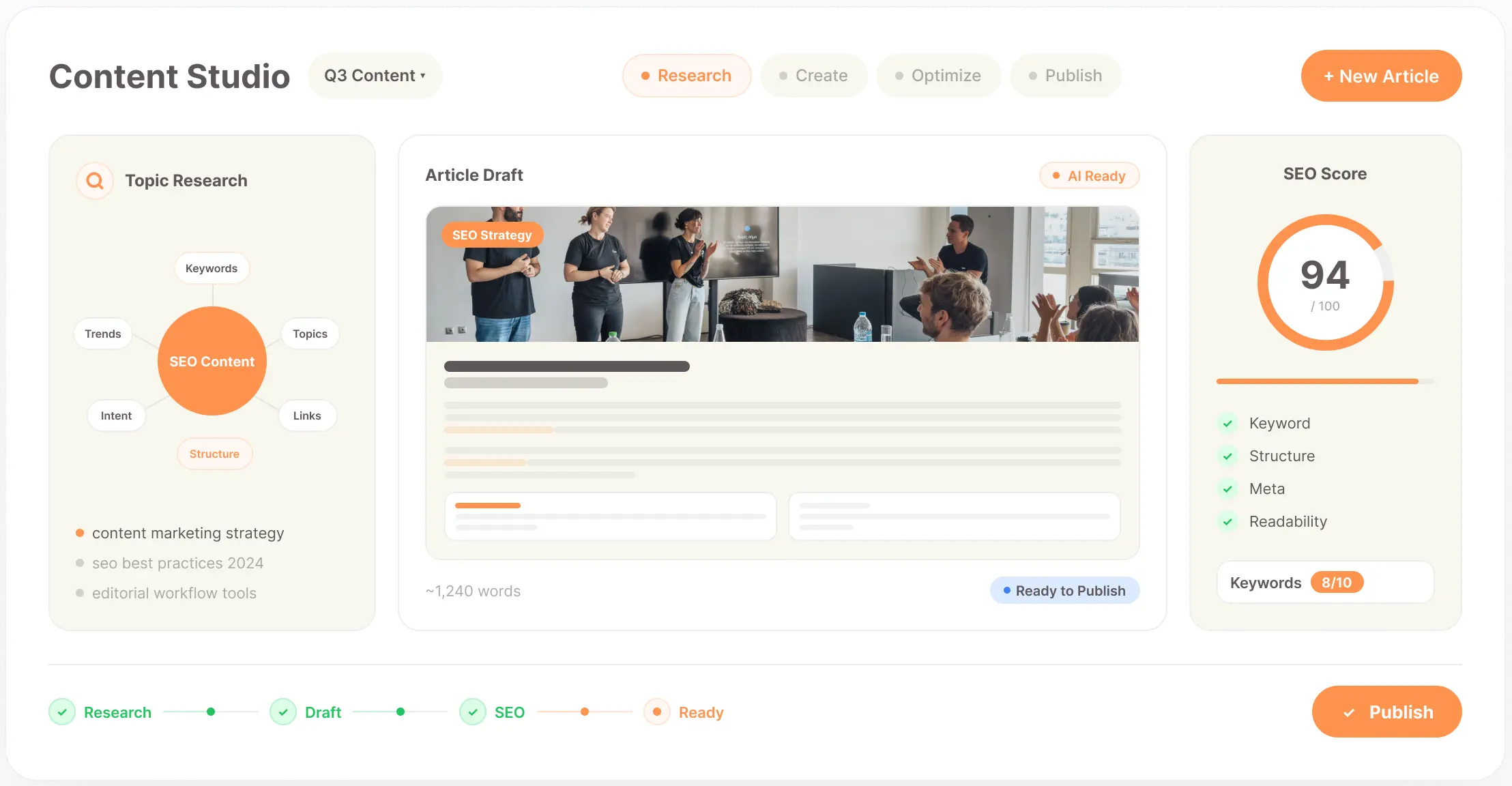
Consistent Content Takes More Than
A Publishing Calendar.
Content marketing works when your brand has something useful to say and a reliable way to turn those ideas into publishable content. But research, topic selection, SEO, outlining, writing and editing often happen across different tools and people, making it difficult to maintain quality while publishing consistently.
You Run Out Of Topics
Finding subjects worth publishing becomes difficult when every article starts from a blank page. Without a structured way to discover topics and opportunities, teams can spend as much time deciding what to write as they do creating it.
Research Takes Too Long
A useful article needs context, supporting information and relevant references. Gathering that information across multiple sources can slow down the process before writing even begins.
Content Lacks A Clear Direction
Publishing regularly does not necessarily mean publishing strategically. When articles are created around disconnected ideas, the content library can become fragmented instead of building a coherent set of topics around the audience and brand.
SEO Gets Added After Writing
Keywords, search intent, metadata and content structure can be difficult to incorporate when they are considered only after an article has already been written. This can lead to unnecessary rewriting and missed opportunities.
Every Article Becomes A Separate Project
When research, outlining, writing and optimisation are handled independently, producing a single article requires multiple handoffs. Scaling that process across a content programme makes consistency increasingly difficult.
Brand Voice Gets Lost
Content created by different writers or teams can vary significantly in tone, terminology and depth. Without a consistent communication direction, individual articles may work on their own but feel disconnected from the wider brand.
A Strong Content Programme Starts
Before The Article.
Effective content marketing requires more than a steady publishing schedule. The topics need to be relevant, the content needs to serve a purpose and the research needs to support something worth saying. A structured process helps connect these decisions before the writing begins.
Relevant Topics
Content should be built around subjects that matter to the audience and have a meaningful relationship with the brand. Topic selection gives the wider content programme a direction instead of creating isolated articles.
Clear Search Intent
Understanding why someone is searching for information helps determine what the article should actually deliver. The content can then answer the underlying need rather than simply repeating keywords throughout the page.
Useful Research
Strong content needs substance behind it. Relevant references, supporting information and existing knowledge give the writer material to work with and help the article move beyond surface-level explanations.
A Defined Content Structure
The article should have a logical progression from the opening idea through its supporting sections and conclusion. A clear structure makes complex topics easier to develop and easier for the reader to follow.
Consistent Brand Communication
Content should contribute to the same brand narrative across the wider marketing ecosystem. The topics may vary, but the language, perspective and communication style should remain recognisable.
Search Optimisation
SEO should be considered during content planning rather than added after the article is complete. Keywords, metadata, headings and relevance should work alongside the content instead of competing with it.
A Repeatable Workflow
A content marketing system needs to work beyond a single article. Teams should be able to move from one topic to the next without rebuilding their entire research and writing process every time.
Ready To Build Content That Works?
Bring your topics, research, SEO direction and brand voice together in one structured content workflow.
Start Building
Turn Content Ideas Into A Repeatable
Publishing Process.
Brandstory AI's AI Blog Writer brings topic research, references, content planning, SEO and article creation into one structured workflow. Start with keywords, a domain or existing content, define what you want to create and develop the article through a series of controlled steps.
Start With Your Topic
Enter up to ten keywords, provide a domain or upload existing content to establish the subject area for your article. The initial input gives the workflow a clear starting point rather than relying on a generic writing prompt.
Choose The Content Format
Select the type of content you need, whether it is a blog post, how-to guide, listicle, comparison, technical article, product review, FAQ or news article.
Build The Research Base
Select relevant references and supporting material that should inform the article. Keep the research connected to the content instead of managing source material separately.
Set The SEO Direction
Define the meta keywords, title and description while establishing the search direction for the article. SEO becomes part of the content setup rather than a final production task.
Shape The Structure
Develop the article's headline and section structure before producing the complete piece. This gives you an opportunity to review the direction and make changes before the writing stage.
Create And Refine
Generate the article from the information and structure you have established, then review and refine the finished content. The process allows you to shape the article rather than accepting the first generated version as the final output.
AI Blog Writer
Build A Content Workflow From Research To Finished Article.
AI Blog Writer is the single product powering the Content Marketing solution. It brings research inputs, content formats, references, SEO settings, structure and article creation into one workflow so teams can produce content without rebuilding the process for every topic.
Keyword & Domain Research
Start with your own keywords or provide a domain to establish the subject area you want to explore. You can enter up to ten keywords during the content setup and use them as the foundation for the article.
This gives your content programme a more focused starting point than simply asking for an article about a broad subject.
Multiple Content Formats
Choose the format that matches the purpose of the content. Create standard blog posts, how-to guides, listicles, comparison blogs, technical articles, product reviews, FAQ pages or news articles depending on what your audience needs.
The format helps establish the appropriate structure before the content is developed.
Reference Selection
Select relevant references to provide additional context for the article. Keeping source material within the writing workflow makes it easier to build content around information that matters to the subject.
References can support deeper articles while giving the writing process more direction than an isolated prompt.
SEO Metadata
Set meta keywords, meta title and meta description as part of the content setup. These elements can be considered alongside the article rather than being added after the writing is complete.
This keeps essential search information connected to the content production process.
Structured Headlines
Develop the article's headline and section structure before generating the complete piece. Review the proposed direction and make changes while the content is still being shaped.
This gives the team an opportunity to establish the article's flow before investing in the full draft.
Content Configuration
Configure the article around its specific requirements before generation. Different subjects and content formats can require different approaches, and the configuration stage allows the article to be shaped accordingly.
The goal is to create content around the actual requirement rather than applying one structure to every topic.
Long-Form Content
Develop comprehensive articles around complex subjects, educational topics, products, services or industry questions. Longer content can be structured into multiple sections so the article has room to explain the subject properly.
The emphasis remains on developing the topic in a useful and organised way rather than simply increasing word count.
Content Refinement & Export
Review the generated article and refine the content before publishing. Changes can be made to the direction, structure and writing so the final piece reflects what your team actually wants to communicate. Take the completed article into your existing publishing workflow once reviewed.
Build Each Article Through A Process You Can Repeat.
Define The Topic
Add keywords, provide a domain or bring existing content into the workflow. Establish the subject and context before beginning the article.
Choose The Format
Select the content type that matches the purpose of the article, from a standard blog post to a guide, comparison, review, FAQ or technical article.
Build The Research Base
Select relevant references and supporting information that should inform the content. Give the article a stronger foundation before moving into writing.
Set The SEO Direction
Define the keywords and metadata associated with the article. Establish the search direction before the content is developed rather than trying to optimise it afterward.
Develop The Structure
Create and review the headline and section structure. Shape the article's progression before generating the complete content.
Generate The Article
Develop the full article using the topic, format, references, SEO direction and structure established in the earlier stages.
Review & Refine
Read through the finished content and make the necessary changes to the structure, information and writing. Ensure the article serves its intended audience and purpose.
Export & Publish
Move the completed article into your existing publishing workflow and continue building the next piece of content from the same structured process.
One Content Workflow For
Different Marketing Goals.
SEO Content
Create articles around relevant keywords and search topics that can become part of your organic content programme. Build each piece around a defined subject, structure and search direction rather than producing disconnected posts.
Educational Content
Develop guides and explanatory articles that help your audience understand a subject, process, product or industry concept. Use structured sections to make complex information easier to explore.
Thought Leadership
Turn a defined point of view or area of expertise into longer-form content that gives your audience more depth than short-form communication can provide.
Product Content
Create articles that explain products, compare solutions, answer common questions or explore specific use cases. Use the content to give potential customers more context during their research.
Comparison Content
Build comparison articles that examine different approaches, products or solutions around a specific topic. Structure the content so readers can understand the differences and evaluate their options.
How-To Content
Create practical guides that walk readers through a process or answer a specific question. A clear structure helps break the subject into useful steps that readers can follow.
FAQ Content
Turn recurring customer questions into structured articles or FAQ pages. Address individual questions directly while creating a reusable resource that your audience can return to.
Industry Content
Build a library of articles around the subjects your brand operates within. Consistent publishing around related themes can help establish a clearer content territory for the brand.
Content Programmes
Move beyond individual articles and create a repeatable publishing process around multiple topics and formats. The same workflow can support a wider content operation without requiring a completely different production method for every piece.
Build A Content System You Can Keep Publishing From.
Turn topics, keywords and research into structured articles through a repeatable content workflow.
Build Your ContentBuild A Content System You Can Keep Publishing From.
Turn topics, keywords and research into structured articles through a repeatable content workflow.
Plan the direction, build the research base, shape the article and refine the final content
before taking it into your publishing process.
Everything You Need To Know
What types of content can I create?
AI Blog Writer supports blog posts, how-to guides, listicles, comparison blogs, technical articles, product reviews, FAQ pages and news articles. You can select the format according to the subject and purpose of the content.
Can I create content around my own keywords?
Yes. You can enter up to ten keywords during the content setup and use them as the starting point for your article. You can also provide a domain to establish the subject area.
Can I use my existing content as an input?
Yes. Existing content can be uploaded as part of the workflow to provide additional context for the article. This can be useful when your team already has research, source material or other information available.
Can I provide references for the article?
Yes. You can select references that should inform the content. This keeps the research connected to the article rather than requiring your team to manage source material separately.
Can I create different types of articles?
Yes. The workflow supports multiple content formats, including guides, listicles, comparisons, technical articles, product reviews, FAQs and news content. The format can be selected according to what the audience and topic require.
Can I control the SEO information?
Yes. You can configure meta keywords, meta title and meta description as part of the content setup. This allows search-related information to be considered during production.
Can I review the article structure before writing the full piece?
Yes. The workflow includes headline development and structural planning before the complete article is generated. This gives you an opportunity to shape the direction and flow before producing the full content.
Can I create long-form content?
Yes. The workflow can be used to develop comprehensive articles around complex subjects, educational topics, products and industry questions. The structure can be used to organise longer pieces into clear sections.
Can I edit the content after it is generated?
Yes. The generated content can be reviewed and refined before it is taken into your publishing workflow. The purpose is to give your team control over the final article rather than treating the initial generation as the finished piece.
Can I create content for different languages and locations?
Yes. The content setup allows you to specify a target location and language, making the workflow suitable for content intended for different markets and audiences.
Can I use this for content beyond SEO?
Yes. While keywords and search optimisation are part of the workflow, the product can also support educational content, thought leadership, product marketing, customer education and industry-focused publishing.
Can I build a complete content programme with it?
Yes. You can use the same workflow repeatedly across different topics and formats. This makes it suitable for teams that want to move from producing individual articles to establishing a more consistent content publishing process. AI Blog Writer is the single product powering the Content Marketing solution.